Energy Comfort Model

One score.
Unlimited intelligence.

ECM is the shared energy language of the Solaire Intelligence ecosystem. A single live number — 0 to 20 — that tells every connected device exactly how much energy your property has to spare right now.

14
Comfortable

Solar surplus available · Battery healthy · Grid off

Smart appliances aren't smart about energy.

Your pool pump, geyser, underfloor heating, EV charger — none of them know anything about your solar panels, your battery, or your grid situation. They just run on a timer and draw whatever power they need.

The conventional solution is a central automation controller that watches the inverter and sends commands. It works — until it doesn't. If the controller is offline, every device goes dumb again.

ECM solves this by giving every appliance a common language — one number they can all read and act on independently, without any central controller.

Without ECM
Each appliance needs its own inverter integration
Central controller pushes commands — single point of failure
Rules and automations to write, test, and maintain
Adding a new device means new rules and re-integration
With ECM
Gateway calculates ECM once — all devices share it
Each device decides autonomously — no central controller
Set thresholds once — no rules to maintain
New device? It reads the same score — zero re-integration

Four inputs. One number.

SI Gateway reads live inverter data over RS485 every few seconds and computes the ECM score from four key energy metrics. No cloud. No delay. Calculated right where the data lives.

☀️
Solar PV Output
How much the panels are producing
🔋
Battery State-of-Charge
How full the battery is right now
Grid Import / Export
Dependency on or surplus to the grid
🏠
Load Demand
What the property is currently consuming
Calculated by
RS485 · local · live
SI Gateway
14
Comfortable
ECM Score · 0–20
HTTP endpoint
local · no broker
SI Pool → run pump?
SI Water → fill tank?
SI Geyser → heat now?
SI EV → charge?

The gateway does the hard work once. Every connected device gets the answer — a single number — and makes its own decision. No device needs to understand solar panels, batteries or inverters. They just need to know the score.

Five tiers. Zero ambiguity.

The 0–20 scale maps to five named tiers. Each device uses these tiers — along with thresholds you configure — to make its decision. The names tell the story at a glance.

048121620
Critical 0–3

Battery low, heavy grid dependency, little or no solar. Protect the essentials — don't run anything optional.

Cautious 4–7

Energy is constrained. Some solar, but the system is working hard to maintain balance. Hold off on high-draw loads.

Moderate 8–11

Stable. Solar is covering load, battery is healthy. Selective loads can run — be deliberate about what you activate.

Comfortable 12–15

Surplus available. Solar well exceeds demand and the battery is strong. The ideal window for pool pumps, heating and charging.

Excellent 16–20

Maximum surplus. Battery full or nearly full, solar production is high, grid is not needed. Run everything — it's free energy.

Devices don't subscribe.
They poll.

Almost every energy automation system distributes intelligence via MQTT — a publish-subscribe protocol designed for IoT. It works well, but it requires a broker that all devices connect to, and every device is only as smart as the rules written for it.

SI does it differently.

SI Gateway exposes the ECM score on a local HTTP endpoint. Each SI device polls that endpoint directly on its own schedule. No broker between them. No subscription. No message queue to fall behind on. Just a device asking a question — and getting an instant, current answer.

MQTT is still there — for the dashboard and Home Assistant. But those are visibility tools. Device intelligence doesn't depend on them.

Works when the broker is offline or unreachable
No message queue — always the freshest score
Fully local — no internet dependency for device decisions
Adding a new device: point it at the endpoint. Done.
Data flow
InverterSunsynk
RS485
Calculates ECMSI Gateway
ECM HTTP →
Decides autonomouslySI Pool · SI Water
data MQTT →
VisibilityDashboard
data MQTT →
OptionalHome Assistant
SI devices use HTTP — no broker required for device intelligence. MQTT is additive, not load-bearing.

SI Pool — the first ECM-native device.

SI Pool reads the ECM score every few seconds. Based on the score, your configured thresholds, and the device's own safety logic, it decides whether to run the pump or heat the pool — without any input from you or any central controller.
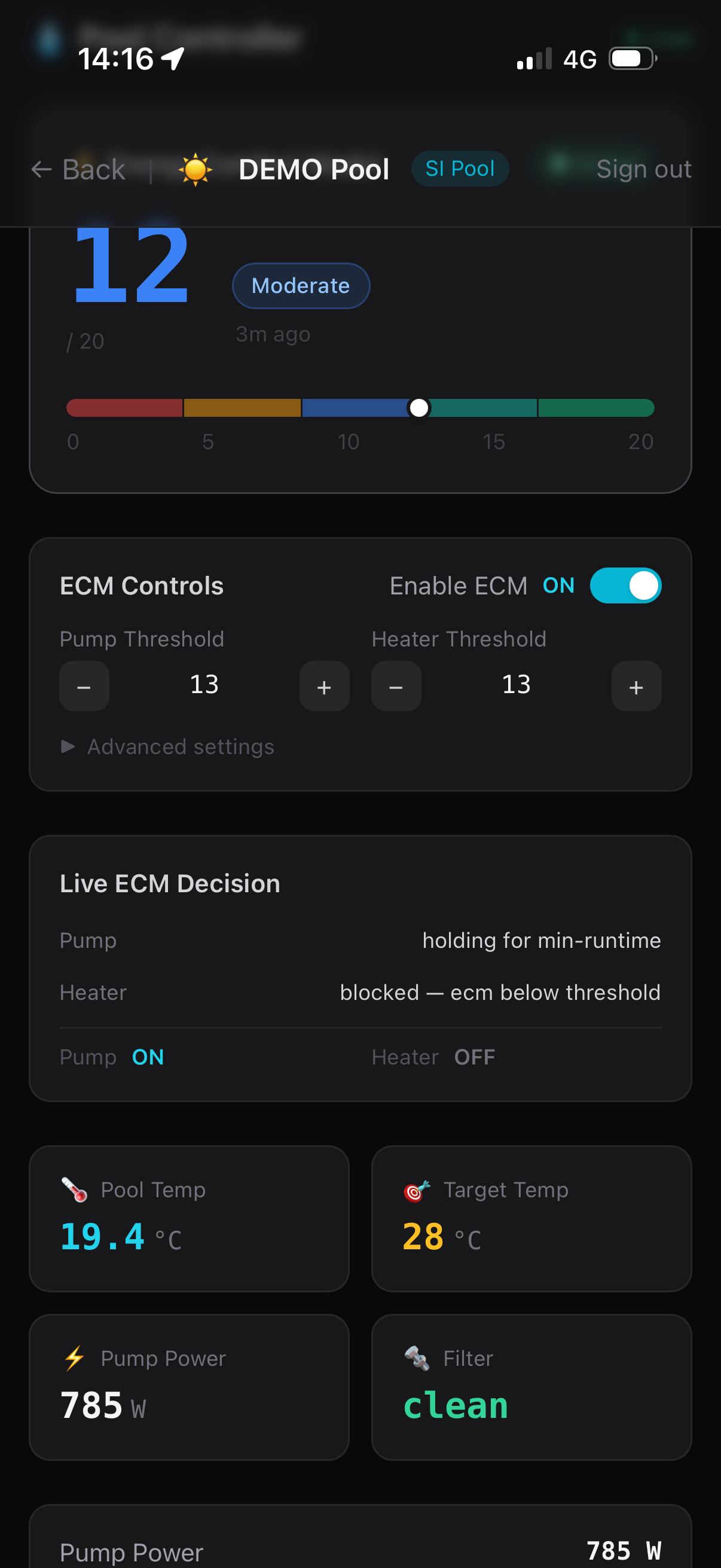
SI Pool — live ECM status, score and tier badge
Status

Live ECM score and tier badge. The device always knows its energy state — at a glance.
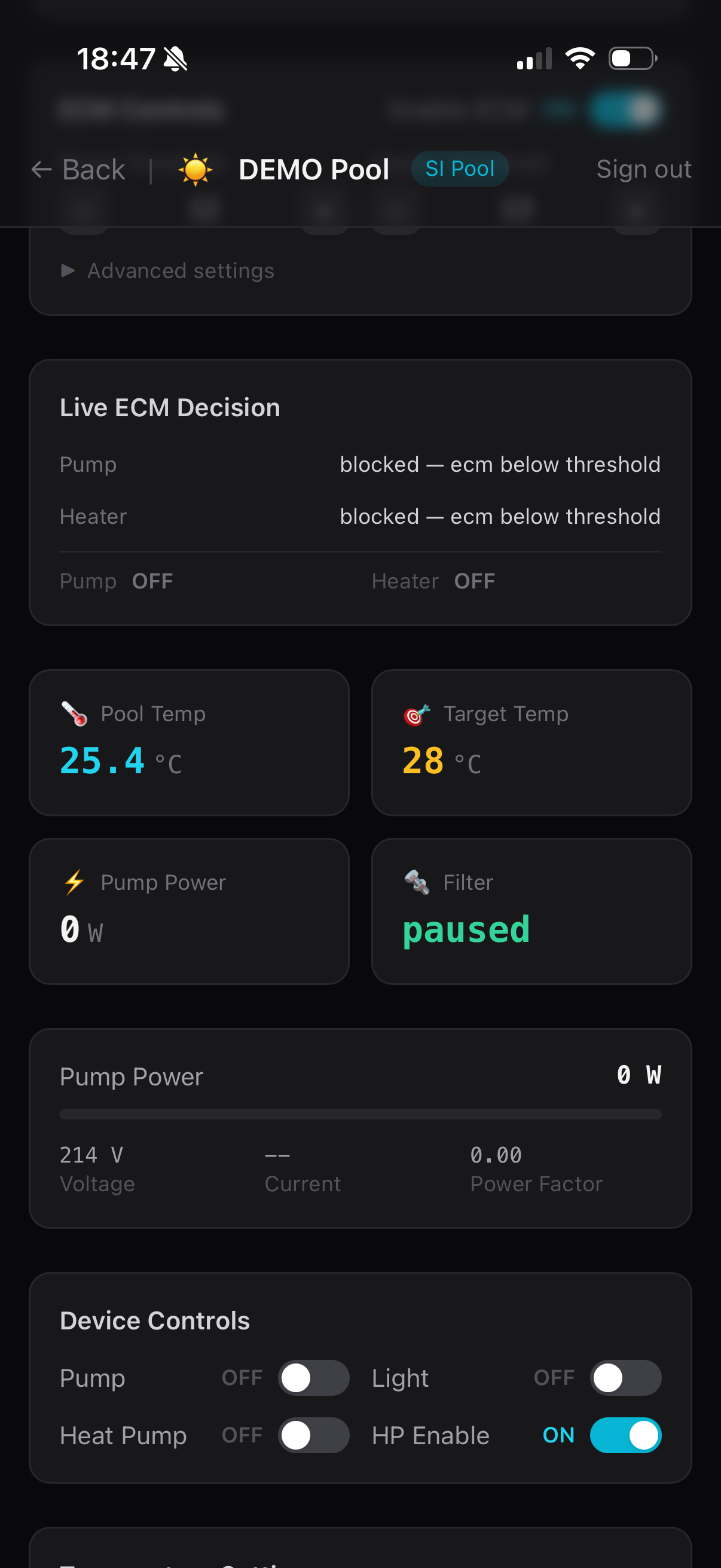
SI Pool — ECM decision screen showing pump and heater reason
Decision

The device tells you exactly why the pump is on or off — which threshold triggered the decision.
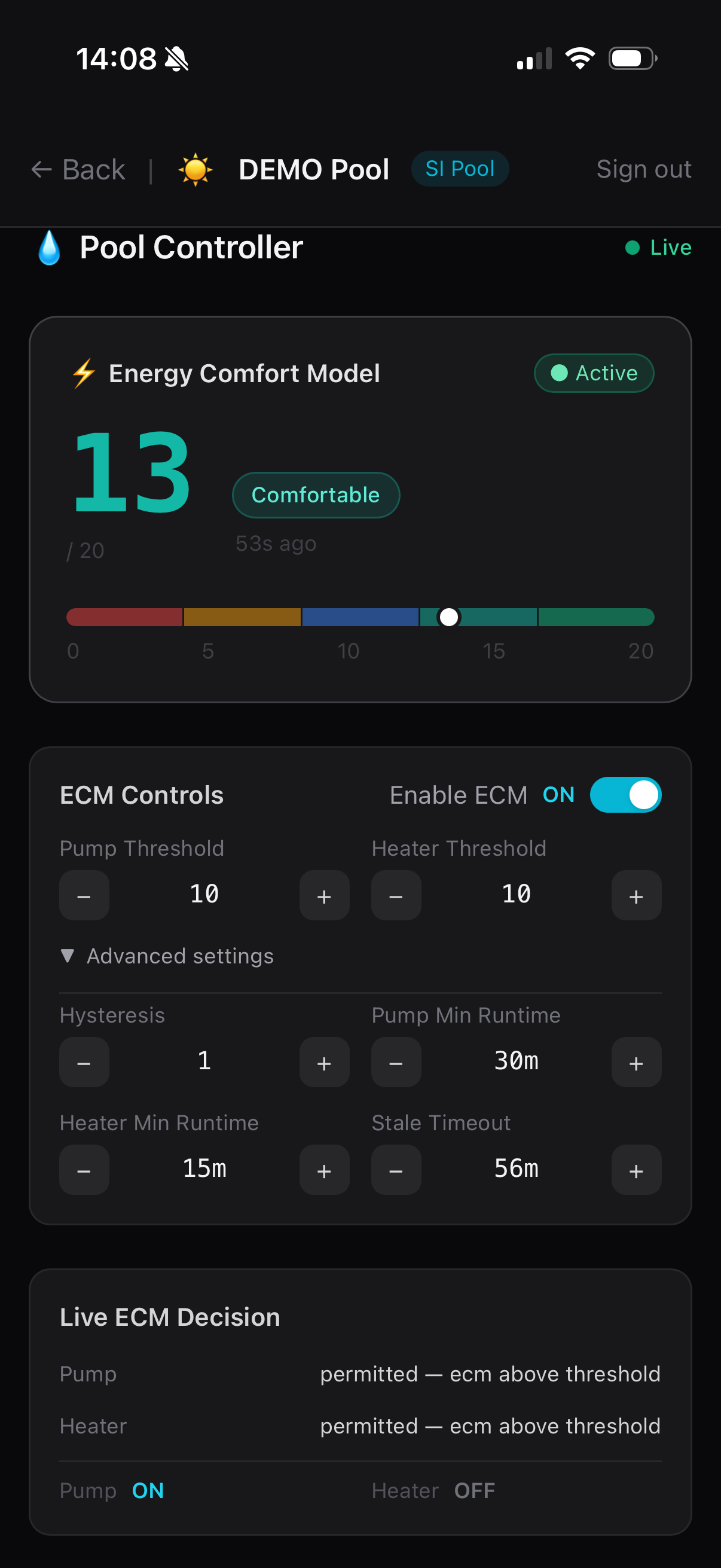
SI Pool — ECM threshold and control settings
Your thresholds

You set the ECM score thresholds. Above this score, run. Below it, stop. The device handles the rest.

No rules. No automations. No YAML. You set two numbers — the minimum ECM score to run the pump, and the minimum to run the heater. SI Pool handles everything from there: hysteresis to avoid cycling, minimum run times, dry-run protection, and a full decision log you can review at any time.
Today it's a pool pump.
Tomorrow it's your whole home.

Because ECM is a standard — a published HTTP endpoint with a stable score — any device we build can speak it from day one. The integration work is done once, in the gateway. Every new SI device is additive, not disruptive.

🌊

SI Pool

Pool pump and heat pump automation. First ECM-native device — live now.

See SI Pool →
💧

SI Water

Borehole and tank monitoring. Borehole pump fills when there's surplus. Live now.

See SI Water →
🚿

SI Geyser

Heat water when energy is Comfortable or better. Only when it's essentially free.

Coming soon
🚗

SI EV

EV charging paused unless ECM is Excellent. Never draw grid to charge your car.

Coming soon
🌡️

SI Climate

Underfloor heating and air conditioning tuned to energy availability. Not just a timer.

Coming soon

One energy language. One score. Unlimited possibilities.

Every future SI product will speak ECM natively on day one. The infrastructure — the gateway, the HTTP endpoint, the scoring algorithm — is already in every home we deploy into. New devices just plug into an ecosystem that's already thinking.

ECM starts with SI Gateway.

There is no ECM without SI Gateway. It's the device that reads the inverter, runs the algorithm, and publishes the score. Everything else in the ecosystem depends on it — and it works whether or not the internet is connected.

See SI Gateway → Talk to an installer
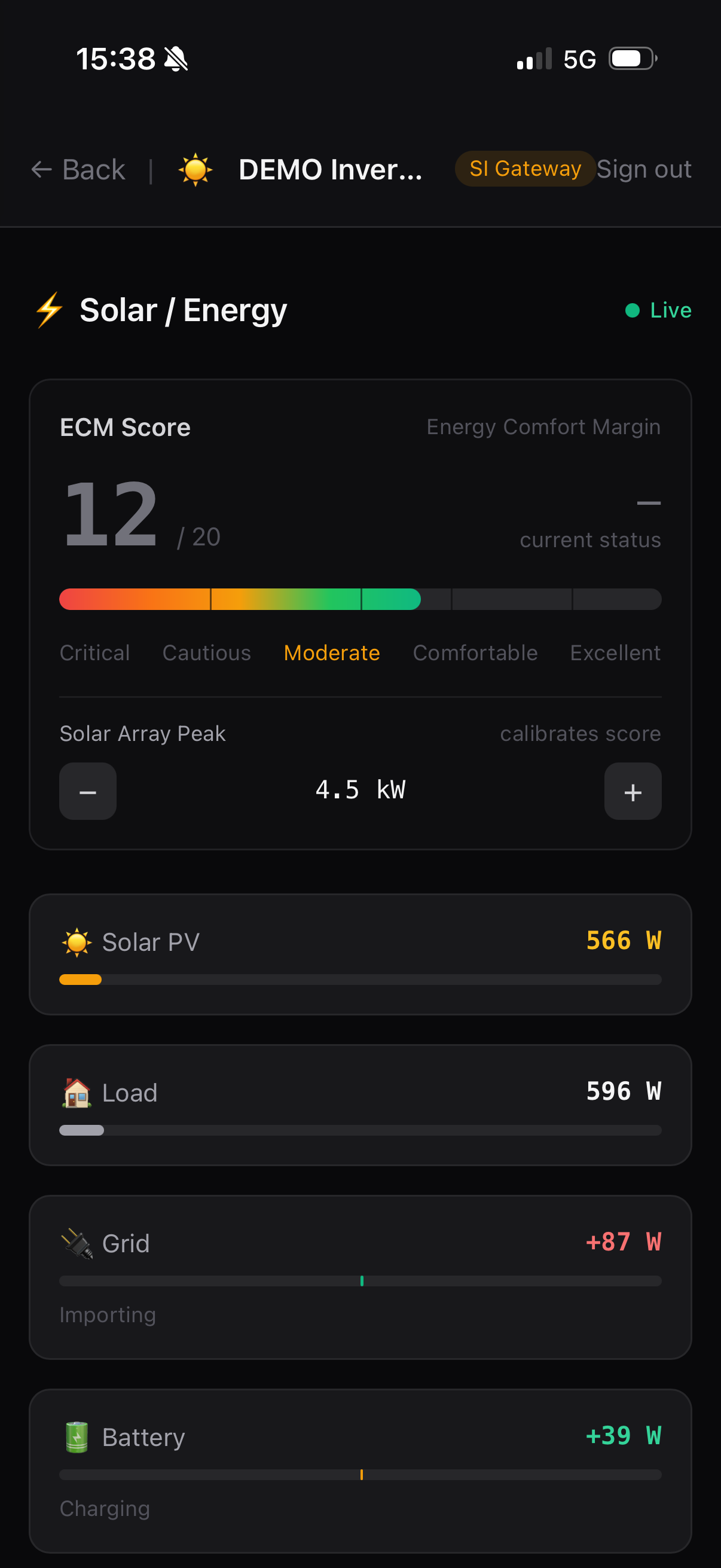
SI Gateway — live ECM score and energy overview